
When it comes to astrology, “The Part of Fortune”, traditionally called Pars Fortunae or the Lot of Fortune, is a best-kept “public” secret. It does not promise sudden windfalls, dramatic reversals, or effortless success. Instead, it promises something far more enduring and worthy.
In a world completely obsessed with speed, visibility, and immediate outcomes, the Part of Fortune asks us to speak in a slower and wiser language. Together, this is where we ask ourselves instead of forcing something into existence in our life, where is it that effort is naturally met with response?
It’s important to remember that astrology was never just meant to be mere entertainment. Its earliest forms were a practical art related to survival, sustainability, and embodiment. Ancient astrologers asked grounded and practical questions: Where will this person thrive? How does life respond when someone participates authentically instead of performatively? The Part of Fortune provides remarkably clear guidance and a value system.
Rather than defining luck as randomness, the Part of Fortune reframes prosperity as coherence. When conscious intention, emotional rhythm, and embodied action align, life opens meaningfully and sustainably towards us. Let’s explore how we can know ours!
Ancient Roots: Before Luck Became Random
The Part of Fortune belongs to a family of sensitive points known as Arabic Parts or Lots, which were widely used in Hellenistic, Persian, and medieval astrology. In these traditions, prosperity was not about accumulation or extravagance but sufficiency. It means just having enough energy, resources, and support to live well and remain whole.
In addition, the Part of Fortune was closely associated with vitality, physical well-being, material stability, and emotional contentment. Astrologers used it to assess whether a person could sustain their life force, maintain their livelihood, and experience a sense of internal satisfaction alongside external functionality.
Think of it as a deeply embodied value system. Charts were cast not only for individuals, but also for crops, cities, and rulers. The question was never simply whether an event would occur, but whether life would function smoothly. The Part of Fortune revealed where human effort met cosmic order with the least resistance, to move forward to a better life.
Fortuna the Goddess: Abundance with Direction
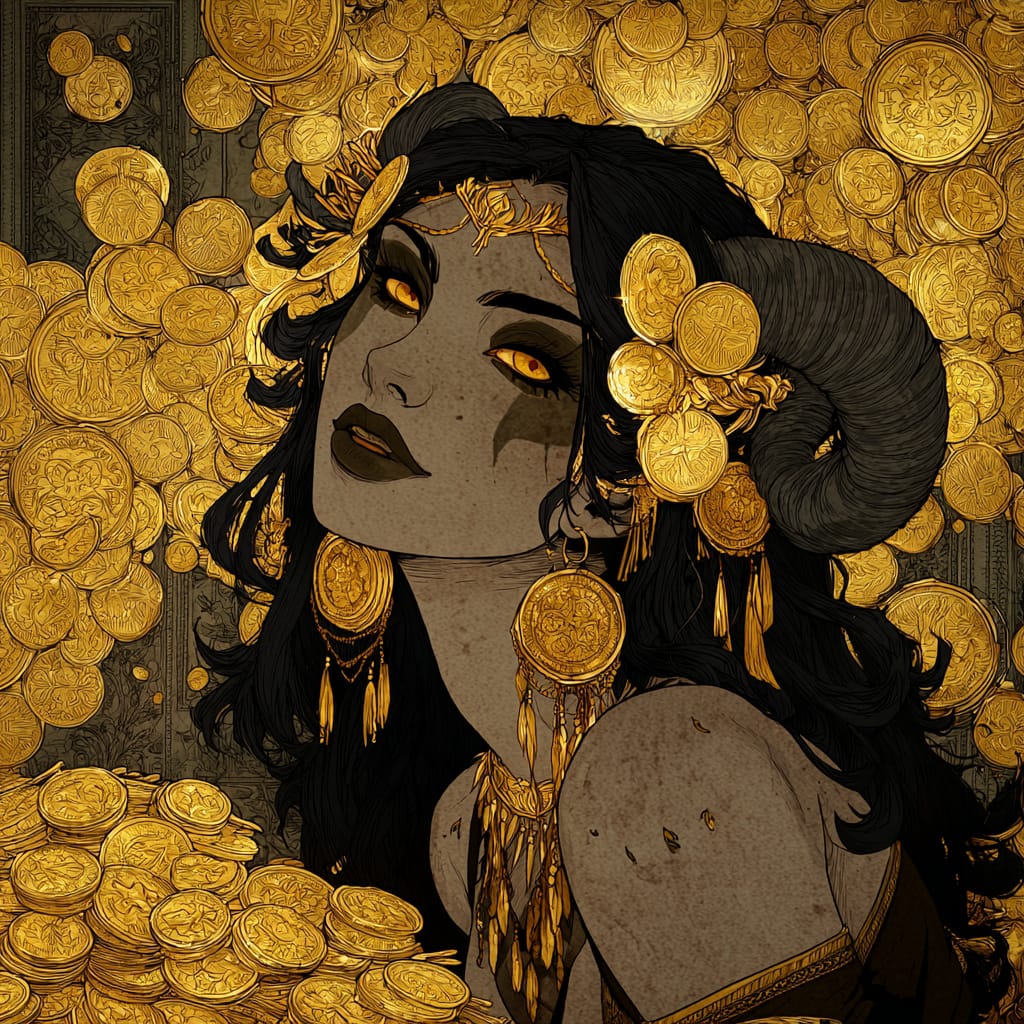
If we go back, this point also strongly references the mythology and philosophy of the goddess Fortuna .In Roman tradition, Fortuna is the goddess of fate, cycles, and prosperity, often described as the daughter of Jupiter, the planet associated with growth, coherence, and expansion. This lineage matters: Jupiter amplifies what already works, while Fortuna shows how that amplification becomes tangible, lived experience for us.
Her image is commonly depicted holding a cornucopia and a rudder. The cornucopia symbolizes abundance and the rudder symbolizes direction. Together, they come to say an essential truth: abundance without orientation is unstable.
Astrologically, this explains why Jupiter is so closely associated with the Part of Fortune. When Jupiter aspects or rules it, opportunities appear more visibly. Yet Jupiter does not create prosperity out of nothing; almost zooming in to what is already coherent and available to us.
What the Part of Fortune Represents
At its core, the Part of Fortune is an equation of how to embody your life, calculated using the Sun, Moon, and Ascendant, the three pillars of lived identity.
- Sun: This is our conscious will, vitality, and purpose.
- Moon: This is our instinct, emotional rhythm, and bodily intelligence.
- Ascendant: This is how we meet the world and how the world meets us.
When these three are in sync, the result is not just personality but efficient functioning. The Part of Fortune shows where effort feels sustainable rather than draining. It describes how happiness arises through participation instead of pursuit, revealing work that restores energy and where material and emotional well-being reinforce one another.
Surprisingly, this is not a point of indulgence or excess. It is a point of exact fit. When we operate in alignment with our Part of Fortune, life feels responsive; when we work against it, and even success can feel hollow. It’s like the puzzle piece we were meant to put together to get the exact picture meant for us. Let us learn how to make our own.
Day and Night Charts: Consciousness Has Rhythm
First of all, traditional astrology distinguishes between day and night births, recognizing that awareness expresses differently depending on whether the Sun is above or below the horizon.
- Day births: Part of Fortune = Ascendant + Moon − Sun
- Night births: Part of Fortune = Ascendant + Sun − Moon
Day charts emphasize visible action and conscious intention; night charts emphasize inner attunement and instinctive response. This distinction is important to keep in mind, as it could change the answer completely. Fortune is personal, exact and it must be made diligently. Otherwise, what nourishes one individual may exhaust another entirely and they could go down the wrong path.
How to Read the Part of Fortune
Interpreting the Part of Fortune requires context; it never operates in isolation. Its sign, house placement, aspects, and ruling planet all interact to reveal where life naturally supports us.
- Locate by sign and house: The sign describes how prosperity wants to move, while the house shows where life most readily responds.
- Examine the dispositor: The planet ruling the sign of the Part of Fortune describes the conditions under which fortune unfolds. A well-aspected, dignified dispositor suggests smoother access. A challenged or hidden dispositor introduces delays, detours, or inner growth before fulfillment stabilizes.
- Assess aspects: Harmonious aspects indicate flow, while hard aspects indicate growth through effort. The Part of Fortune does not remove challenges; it ensures that prosperity is meaningful.
Here are two examples, just to show how nuanced this point can be!
Example One
Consider a chart with the Part of Fortune in Virgo in the 6th house, ruled by Mercury in Capricorn in the 10th house. On the surface, this suggests fulfillment through service, skill-building, and daily usefulness. But examining the ruler deepens interpretation: Mercury in Capricorn in the 10th indicates that this person finds prosperity by mastering a craft that is publicly recognized. Mundane work drains them, while meaningful contribution restores energy. Their alignment grows when their precision meets professional responsibility.
Example Two
Now imagine a Part of Fortune in Sagittarius in the 9th house, ruled by Jupiter in the 1st house. Fulfillment arises through exploration, teaching, publishing, or lived philosophy. Jupiter in the 1st emphasizes that embodiment is key: life responds when this person lives their truth visibly, not privately. Suppressing curiosity causes stagnation; embracing movement, study, teaching, or inspiration opens opportunities.
Embodiment, Effort, and the Myth of Passive Luck
Interestingly, a persistent misunderstanding is that the Part of Fortune operates passively. Many assume that once it is identified, fortune should arrive automatically. Ancient astrologers never treated it this way. The Part of Fortune is responsive to us, not a reward system.
Fulfillment emerges in our life when our effort is placed where it can circulate. Misplaced effort, even if successful externally can feel hollow and meaningless. Two people may achieve similar outcomes, yet only one feels nourished by them. The Part of Fortune explains why.
For instance, someone with a strong 10th-house emphasis but a Part of Fortune in the 5th house may achieve professional recognition while quietly feeling disconnected. Until creativity, joy, or self-expression are reintegrated, satisfaction will evade. The chart does not contradict itself while clarifying what needs to get priority. The Part of Fortune is best read as a compass rather than a destination, it shows where life responds when you engage fully.
The Elements: How Prosperity Moves
The element of the Part of Fortune describes the energetic pathway through which our prosperity flows:
- Fire signs: Thrive through initiative, courage, creativity, and leadership. Sustainability requires awareness rather than impulsivity.
- Earth signs: Prosper slowly and steadily. Wealth grows through patience, craftsmanship, land, systems, and tangible contribution.
- Air signs: Generate fortune through communication, teaching, networking, writing, and exchange of ideas.
- Water signs: Experience prosperity through emotional intelligence, intuition, care work, inheritance, and sensitivity. Feeling deeply becomes a resource.
The Zodiac Signs: The Shape of Fulfillment
- Aries: Autonomy, pioneering action, self-started initiatives
- Taurus: Stability, cultivation, grounded embodiment
- Gemini: Learning, teaching, connection, curiosity
- Cancer: Emotional security, family, home, nurturing
- Leo: Creativity, visibility, joy, performance
- Virgo: Service, refinement, usefulness, skill mastery
- Libra: Harmony, partnership, aesthetics, relational equilibrium
- Scorpio: Depth, shared resources, transformation, intimacy
- Sagittarius: Exploration, meaning, philosophy, teaching
- Capricorn: Mastery, responsibility, career, legacy
- Aquarius: Innovation, community, future-focused projects
- Pisces: Compassion, spirituality, dissolving boundaries, imagination
Each sign shapes the style of prosperity, indicating not just the area of life but the approach that aligns with an individual’s innate rhythm.
The Houses: Where Life Meets You
The house placement of the Part of Fortune reveals where effort is most readily reciprocated, showing the arena in which life naturally supports growth:
- 1st house – Fulfillment through authenticity, self-direction, and presence
- 2nd house – Through self-worth, income, and skill valuation
- 3rd house – Communication, writing, teaching, and local networks
- 4th house – Family, home, ancestry, and emotional roots
- 5th house – Creativity, joy, performance, children
- 6th house – Service, health routines, meaningful work
- 7th house – Partnership, collaboration, and cooperation
- 8th house – Shared resources, investments, inheritance, psychological depth
- 9th house – Travel, philosophy, education, global connection
- 10th house – Vocation, leadership, contribution
- 11th house – Community, networks, collective vision
- 12th house – Subtle but lasting support through healing, spirituality, and behind-the-scenes service
Practical House Examples:
- 2nd house Taurus – Prosperity comes through patience, consistent effort, and honoring one’s skills.
- 2nd house Aries – Thrives through entrepreneurship, self-started income, and calculated risk.
- 7th house Libra – Fulfillment arises through aesthetic harmony and balanced partnerships.
- 7th house Scorpio – Access to resources comes via shared ventures, deep emotional bonds, or therapeutic alliances.
The house is the arena; the sign is the strategy. Together, they describe how effort aligns with natural support.
Sources of Wealth According to the Birth Chart
While the Part of Fortune describes where fulfillment flows, traditional astrology also considers how wealth and resources are generated. This does not reduce the chart to money alone; rather, it clarifies channels for stability and support in our lives.
Wealth Through Relationships and Marriage
Remember, prosperity is often relational as well. Wealth through partnership or marriage is indicated when the Part of Fortune or its dispositor is connected to relational and benefic symbolism.
- Key indicators: Part of Fortune or its ruler in Libra, or placements in Cancer, Taurus, or Leo, with harmonious aspects to Venus, Jupiter, or the Moon.
- House emphasis: 2nd, 7th, or 8th, where resources are exchanged, shared, or stabilized.
Practical manifestation: Financial improvement after marriage, business growth via partnerships, or family support. This is an example of co-creation, not dependency.
Lottery, Gambling, and Sudden Gains
Sudden or unexpected gains are linked to more fluid examples, often seen in Pisces or Virgo placements with aspects from Neptune or Uranus. While this may include lotteries, it usually manifests as unexpected opportunities, benefactors, or irregular windfalls. It is important to discern, these gains are often cyclical rather than stable.
Art, Talent, Craft, and Aesthetic Wealth
Prosperity through creativity appears when the Part of Fortune is in Cancer, Leo, Virgo, Pisces, Libra, or Scorpio, supported by the Moon, Venus, Jupiter, or Neptune. These charts show wealth flowing through beauty, design, fashion, healing arts, music, writing, or craft. Emotional or aesthetic resonance is key: when the work moves others, resources follow.
Intellectual Work, Innovation, and Strategy
Charts emphasizing Aries, Gemini, Scorpio, Sagittarius, Capricorn, or Aquarius, with aspects from Mercury, Saturn, Uranus, or Pluto, indicate success via ideas, technology, or strategic application. Houses 3 and 9 highlight learning, teaching, publishing, and innovation. Prosperity arises when intellectual contributions are applied and shared effectively.
Financial Challenges and Periods of Constraint
Not all charts promise ease. Financial challenges appear when the Part of Fortune or its dispositor is afflicted by Saturn, tense lunar aspects, or Uranus. These placements do not deny wealth but signal that resources require discipline, maturity, and adaptability. Over time, such charts cultivate resilience and long-term wisdom which are a wealth of their own.
Traditional Evaluation of the Part of Fortune
Now, understanding the Part of Fortune requires the understanding of the work of two key figures in astrology: Claudius Ptolemy and William Lilly. Their approaches, though centuries apart, complement each other, one philosophical, the other practical. Together, they offer a full picture!
Claudius Ptolemy and the Tetrabiblos
Claudius Ptolemy was one of the most influential astrologers of the ancient world. His work, the Tetrabiblos, laid the foundation for much of classical astrology. He focused on astrology philosophically, focusing on principles and patterns rather than rigid predictions.
Regarding the Part of Fortune, he taught that material prosperity should be evaluated by three factors: the Part of Fortune itself, its ruling planet, and the aspects between them. When these points are well-placed—especially in harmonious connection with benefic planets like Jupiter or Venus—they indicate comfort, sufficiency, and stability. On the other hand, if these points are weak, afflicted, or poorly positioned, prosperity may be delayed, unstable, or require extra effort to maintain.
This helps us understand why fortune flows or falters, emphasizing the responsiveness of life to alignment, preparation, and timing, rather than luck alone.
William Lilly and Christian Astrology
Next, William Lilly, a 17th-century English astrologer, brought astrology into a practical, hands-on context. His book Christian Astrology is a cornerstone of Western astrology, particularly for predictive and technical chart work. Lilly focused on how strongly fortune can manifest, providing detailed rules for evaluating the Part of Fortune.
According to Lilly:
- The Part of Fortune is strongest in Taurus and Pisces
- Very strong in Gemini and Virgo
- Moderate in Libra, Sagittarius, Leo, and Cancer
Fortuna’s influence is enhanced when it forms Harmonious aspects—conjunctions, trines, or sextiles such as with Jupiter or Venus, or is positioned in the terms of benefic planets.
Additionally, alignment with certain fixed stars, such as Regulus or Spica, strengthens its effect. Conversely, the Part of Fortune can be weakened when it is combust (too close to the Sun) or heavily afflicted by challenging planets.
Integrating Ptolemy and Lilly
By combining the approaches of these two astrologers, we get a complete understanding:
- Ptolemy shows why prosperity flows, emphasizing alignment, readiness, and the responsive nature of life.
- Lilly shows how strongly it manifests, highlighting technical factors that indicate tangible results in the material world.
Together, they remind us that the Part of Fortune is not a guarantee of wealth or luck, but a guide to where effort and alignment are most likely to be met with support. It’s a responsive point: prosperity emerges when we engage meaningfully, rather than waiting passively for fortune to strike.
Why Fortune Is Relational To The Ruler And Transit
The ruler of the Part of Fortune’s sign is essential in interpretation. A strong dispositor opens doors; a challenged one requires development. A part of Fortune in Cancer ruled by a debilitated Moon requires emotional maturity for stability. Hard aspects from Saturn, Mars, or Pluto indicate earned prosperity through endurance, discipline, or transformation. Transits to the Part of Fortune often signal recalibration periods, Jupiter expands access and Saturn restructures alignment.
Living Your Part of Fortune
Overall, this teaches us alignment does not mean avoiding challenges, it means choosing nourishing challenges. Misalignment produces fatigue or restlessness; alignment produces ease, emotional regulation, and energy circulation.
The better attention to detail, the better we lead. In the end, The Part of Fortune reminds us that abundance is responsive, not accidental. When will, emotion, and embodiment align, life meets us halfway. Prosperity here is not excess, but enough; not fantasy, but a life that works.
© 9 January 2026. Written with love and compassion for the planetary movements, and a deep passion for astrology by Kai from @Astro Kai and Fatima Saleh. All rights reserved.